Engineer the light
Shift the focus from the placement of light sources to optical delivery, extraction and distribution.
Beyond generating light, we engineer where and how it is delivered. Precision optical materials and controlled light distribution for a new generation of industrial systems.
LUXIS Technologies Inc. is a Delaware-incorporated company focused on optical technology development and licensing. Its strategy builds on SolarOptics' optical engineering foundation in Korea to pursue international commercialization, collaborative development and local production capabilities.
Shift the focus from the placement of light sources to optical delivery, extraction and distribution.
Built around the OSL technology developed by Sukman Bae and the optical and manufacturing engineering foundation of SolarOptics.
Pursue U.S.-centered commercialization, sector-specific licensing, collaborative research and production infrastructure in phases.

The registered office is the address in the incorporation records, not a representation of a staffed operating headquarters.

Founder of SolarOptics · OSL core technology developer
Sukman Bae founded SolarOptics in 2018 and developed its OSL optical technology. His career spans computing, display and optical engineering, precision optical-fiber processing, manufacturing equipment development and international technology commercialization.
Deterministic side-light extraction, directional light distribution and precision micro-optical structures on polymer optical fibers.
Optical fiber processing equipment, repeatable micro-structuring and application-specific optical modules.
Connecting patents, prototyping, testing, engineering partners and sector-specific licensing strategies.
Digital media, display and optical applications; Korea–Thailand technology exchange through EMTAC-ASIA from 2006.
Historical industrial technology cooperation agreements with Naresuan and Kasetsart universities in Thailand, followed by solar technology collaborative research and field testing.
Founded SolarOptics; advanced fiber-based optical extraction and OSL industrial applications.
U.S. patent US 11,038,073 B2 granted for a solar power generation unit and system.
Japanese lighting-sector cooperation and exhibition activities; U.S. optical fiber processing apparatus patent granted in 2025.
Color-changing side-emitting fiber lighting patent recorded in Korea; further optical application R&D and research collaboration discussions.
Solar power generation unit and system
Optical fiber processing apparatus
Color-changing lighting device using side-emitting optical fiber (company patent record)
93 patent and design filing/registration records were listed in the company’s portfolio as of 21 October 2025. This count is not a statement of 93 currently valid granted patents or exclusive ownership by LUXIS. Inventorship, ownership and licensing are distinct; historic university agreements do not imply current active partnerships.
An optical manufacturing platform designed to extract guided light from polymer optical fibers at controlled locations and directions.
Spatial separation of the light engine and emitting region enables flexible linear and curved light distribution. Guided power still attenuates; uniformity is a design and validation outcome, not the absence of optical loss.
Explore emission, lens geometry and RGBW in the dedicated lab.
Open 3D optical labDesign axial distribution and emission direction around application requirements.
Separate the light engine from the emitting region to expand thermal-management and service options.
Connect optical design, fabrication, inspection and quality management in one engineering workflow.
SolarOptics equipment development and archived physical demonstrations underpin the OSL engineering platform. The following selected materials are distinguished from AI-generated application concepts. They document technology development, not the current capacity of a LUXIS-operated factory.
Recorded prototype demonstration: multiple small arches around plants, showing close-range pink and white illumination. Edited 11-second footage; crop growth and power savings require separate testing.
Play MP4 directlySix edited demonstration videos and three photo references illustrate optical patterns, seat trim and plant arch lighting.
Explore source visualsChevron and speed-limit signs, red and multicolor lattices, wave patterns and dot-array modules. Read the observed optical patterns and related industrial proposals. Play nine edited demonstration highlights.
Read the 2025 video reviews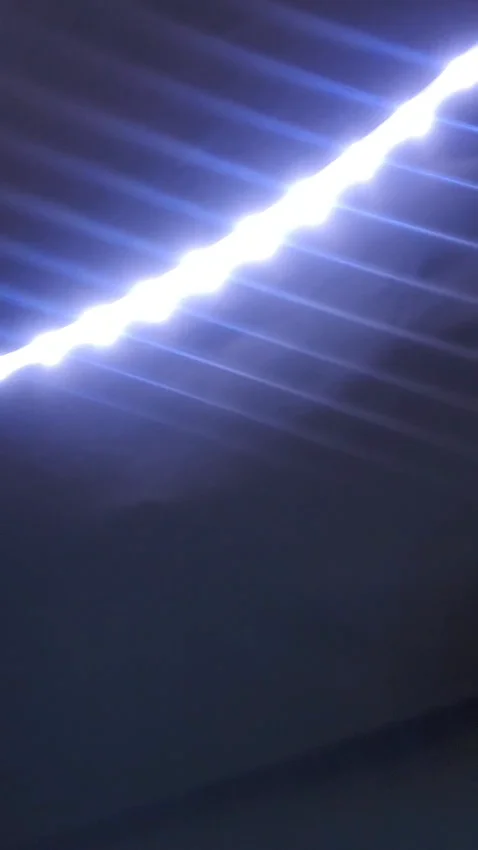
OSL uses engineered optical extraction to distribute guided light along selected locations and directions. The remote light engine can be separated from the emitting region. Linear and curved modules provide application-specific light delivery.
The following are selected archived recordings, not AI-generated images. Apparent brightness depends on exposure, optics and shooting conditions. Quantitative luminance, illuminance and angular distribution require calibrated measurements.
Recorded flexible optical fiber with bright emission along straight and curved sections. The light streaks visible in the camera are not measured ray trajectories.
A physical panel prototype with multiple wave-shaped emitting fibers. Demonstrates a route toward patterned area lighting and decorative optical modules.
An outdoor demonstration of a continuous green luminous route arranged in loops. Potential safety and guidance applications require product-specific visibility and regulatory testing.
Recorded linear red-light prototype with repeating bright points. A development sample for integrated warning, accent and signaling concepts, not a certified automotive lamp.
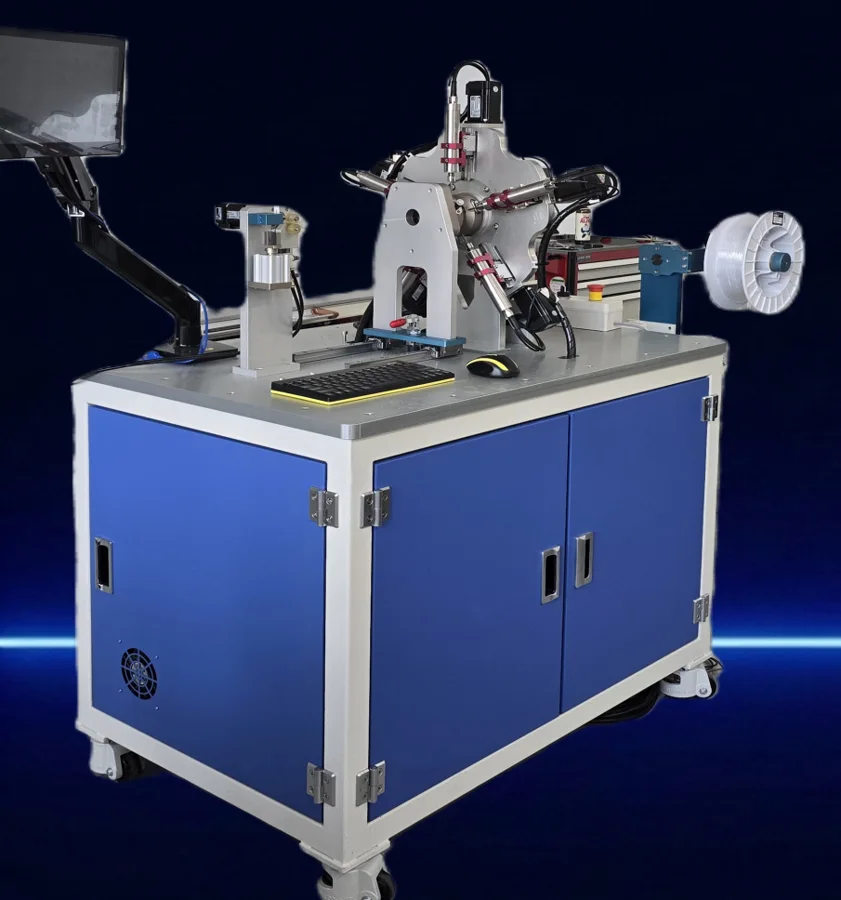
Dedicated fiber processing, optical pattern formation and coordinated production control. SolarOptics announced automated micro-processing equipment development in 2022; a 2023 public report describes its own production equipment development. Current equipment delivery and throughput depend on configuration and acceptance testing.
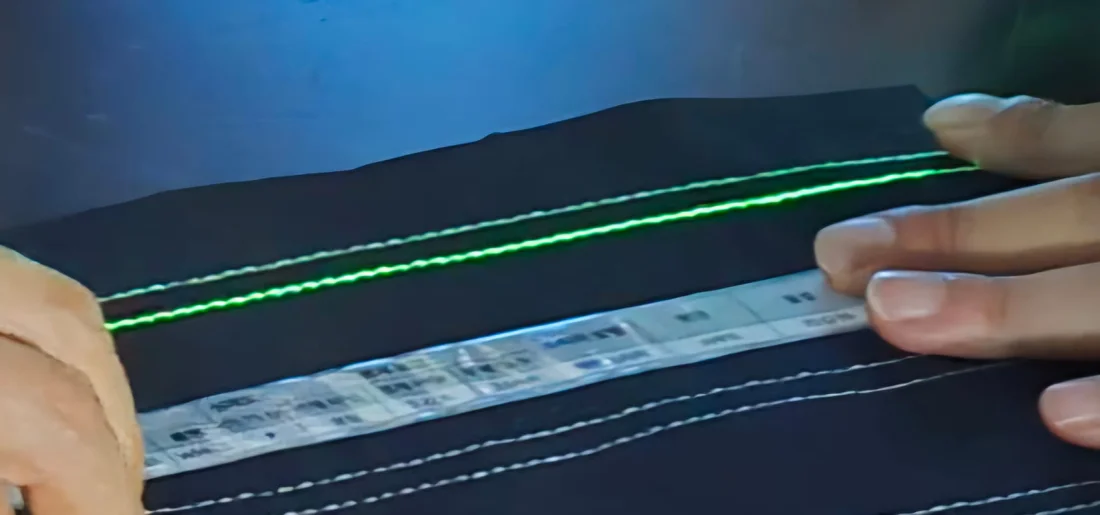
A photographed green-emitting fiber sample illustrates linear side emission. This is a visual demonstration, not a calibrated measurement of luminance, uniformity or optical efficiency.
A short recorded demonstration of green light along curved fiber routes. The footage illustrates form flexibility, not a guaranteed bend radius or service life.
A recorded red-light prototype showing a crossed-line optical pattern integrated in a housing. It is an application-development sample, not evidence of a certified or mass-produced vehicle component.
Process transfer includes application requirements, controlled pattern design, sample fabrication, optical inspection and production qualification. Detailed geometry, tooling, recipes and control software are available only through authorized technical diligence.
An independent, interactive workspace for exploring OSL optical design and next-generation R-LDT research concepts.
Illustrative model only; not a photometric simulation, manufacturing geometry or measured performance.
Explore the conceptual relationship between a reflective surface, localized output apertures and directional emission.
Not measured photometry. No confidential internal structure, material recipe or commercial performance claim.
Explore mobility, industrial safety and agriculture as priority opportunities, alongside wider industrial applications. Each illustration depicts an application concept, not a commercial deployment.
Explore representative products, optical architecture, validation gates and cooperation pathways with application illustrations. The existing 17-domain atlas is expanded by six application-specific briefs.
Open industry proposal libraryLicensing, optical materials and production equipment form the core business model, supported by application engineering and technology transfer. Availability and rights are subject to agreement.
Reflective Micro-Lens Distributed Transmission Fiber
A next-generation reflective light-distribution research platform targeting higher luminance and more precise directional delivery.
Exterior mobility lighting, precision industrial illumination and future optical systems are research targets. Performance, manufacturing and compliance remain subject to validation.
Research and development · Not a commercial specificationReflective Micro-Lens Distributed Transmission Fiber. Illustrative images; not measured photometry or production specifications.


Application development and validation on the Gen-1 foundation.
Customer qualification, pilot manufacturing, reproducibility and standardization.
Research and validation of R-LDT and advanced optical applications.
Three research tracks use the same optical distribution foundation in different ways: photons delivered to biomass, to imaging fields and to photovoltaic cells. Each is a separate validation program.

OSL fibers distribute light within a photobioreactor rather than relying exclusively on external illumination. The research seeks to reduce self-shading and local thermal loads while tuning the spectrum and light field to the culture.
Immersed or protected linear, vertical and helical emitting fibers; remote light engine, selectable red/blue spectral channels and controlled photoperiod.
Proposed 20 L comparative cultivation test against conventional LED and fiber illumination: internal photon flux density, spectral irradiance, biomass productivity, product yield, energy per unit biomass, temperature, fouling and cleaning.
Algal biomass, pigments and other bio-based materials; food/feed, cosmetic ingredients and bioenergy research, subject to product-specific requirements.
Growth and energy savings are research hypotheses, not validated OSL cultivation performance.
Discuss joint research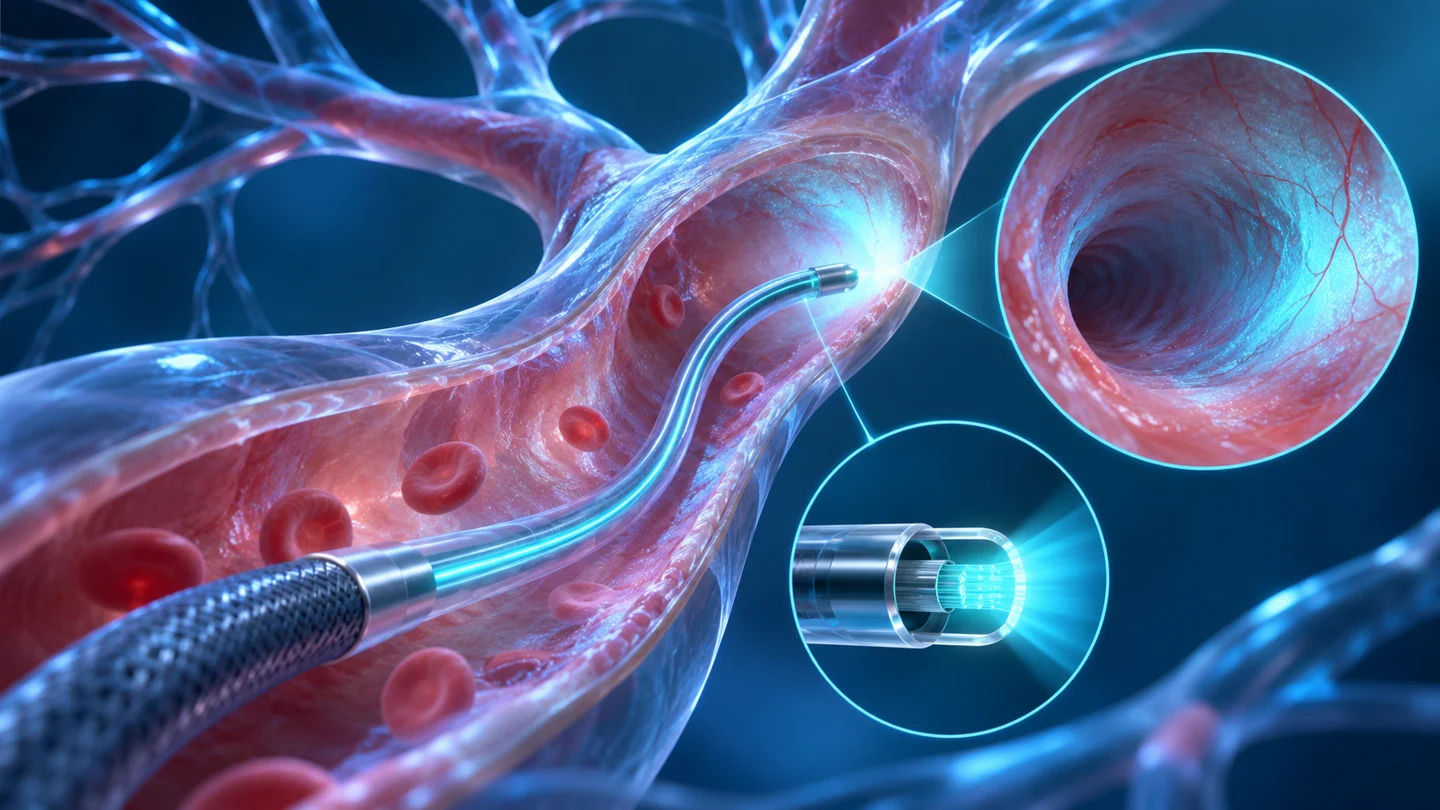
Research into miniature fiber-optic illumination modules for endoscopic observation and intravascular light delivery. Directional side emission and controlled light distribution are investigated as alternatives to relying only on distal-tip illumination.
A remote optical source feeds a miniature fiber within a transparent protective sheath. Side-emitting zones, ring illumination and compatibility with imaging optics are development concepts; fiber diameter is not the complete catheter diameter.
Bench and phantom tests: spectral irradiance and dose, angular distribution, image contrast under blood/tissue scattering, temperature rise, mechanical integrity, biocompatibility, hemocompatibility and sterilization compatibility.
OEM optical components for endoscopy and biophotonic research; future diagnostic or therapeutic applications require dedicated evaluation and authorization.
Illustration is a research concept, not a clinical image or approved device. No diagnostic or therapeutic efficacy or safety claim is made.
Discuss joint research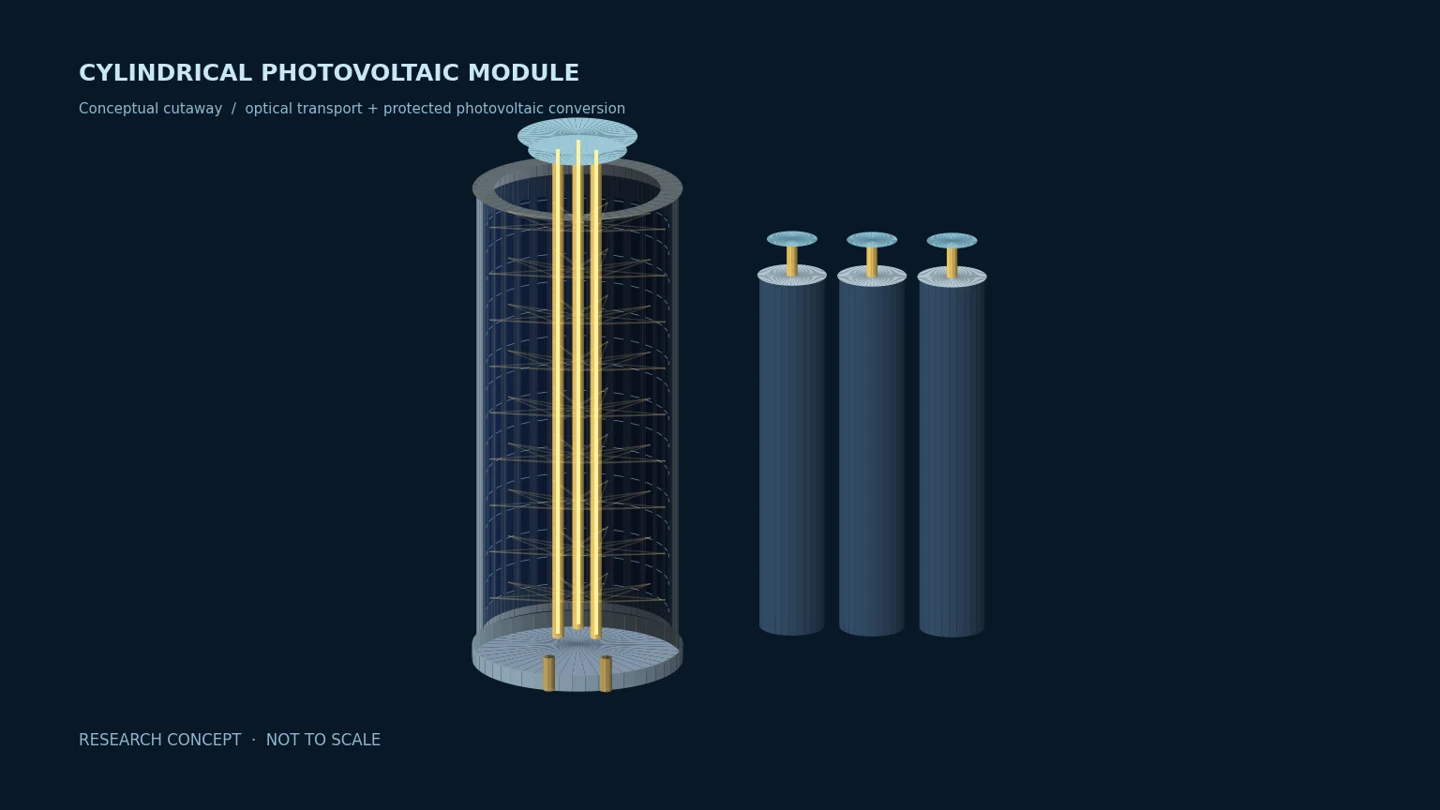
A proposed cylindrical photovoltaic architecture separates sunlight collection, optical transport and protected photovoltaic conversion. OSL delivers collected light toward photovoltaic cells inside the module; the output is electrical energy, not illumination.
Central optical delivery, protected inner photovoltaic elements, enclosure and power management. Single bars can be studied as arrays or matrices. Candidate cells include organic and other thin-film photovoltaics.
Company records describe prior OSL/organic-photovoltaic joint testing with KIMS. Next steps are optical power balance, spectral matching, DC output, thermal and seal reliability, shading and annual energy yield versus a reference PV system; proposed 100 W then 1 kW pilots.
Architectural and agricultural energy integration, compact infrastructure and distributed photovoltaic modules; feasibility depends on measured system-level yield and economics.
Conceptual cutaway, not to scale. Pilot output and efficiency advantages are not established commercial specifications; optical input energy and all losses must be accounted for.
Discuss joint researchPerformance claims must be traceable to the sample, test conditions and measurement method. Engineering predictions, measured results and development targets are distinguished.
Review measured illumination and light distribution by color without conflating differing uniformity definitions.
Environmental tests such as thermal cycling and low-temperature bending apply to the specific tested specimens and conditions.
Manage IP across principles, processes, equipment and applications; ownership and registration status are verified during diligence.
Detailed geometries, manufacturing recipes, unpublished IP and raw data are not public. Detailed requests are subject to approval and NDA review.
A filing-history confirmation dated October 21, 2025, issued by Y.P. Lee, Mock & Partners, lists 93 application records naming inventor Suk Man Bae. The list covers a broader invention portfolio, including 31 design entries and 62 patent-category entries across national and international filings.
This is a historical filing count, not 93 granted patents, not a count of unique inventions, and not a statement that LUXIS owns all listed rights. Rights, scope, licensing and current status must be checked separately.
Representative records connected with Suk Man Bae's optical technology development. Grant publications and published applications are distinguished. Ownership, licensing and present enforceability require separate jurisdiction-specific verification.
Precision formation of optical extraction structures.
View public recordPublic U.S. grant for fiber processing technology.
View public recordEuropean grant publication; national validation and renewal status must be checked separately.
View public recordFiber-delivered light and photovoltaic conversion in a tubular structure.
View public recordPublished international application, not a granted worldwide patent.
View public recordPublished international application concerning optical-source coupling and side lighting.
View public recordOptical transport and light coupling technology.
View public recordFurther development of light transporting media.
View public recordJapanese grant in the fiber-processing technology family.
View public recordRelated Japanese divisional grant; check the current rights holder separately.
View public recordChinese grant in the fiber-processing technology family.
View public recordPublished PCT application covering a light-transport medium and manufacturing method; not a worldwide grant.
View public recordThe engineering evaluation framework below identifies the relevant measurement categories. Test-report originals and report-derived results are not published here because their use is subject to issuer restrictions and approval.
Illuminance distribution by position and color, longitudinal uniformity, optical output and input electrical power. Compare under matching optical and geometric conditions.
Thermal shock, temperature cycling, heat resistance and low-temperature bending. Assess luminance change and visible defects under specified conditions.
Mechanical properties of fiber specimens, material compliance documentation and application-specific integration tests. Supplier and related-product records do not certify OSL finished products.
OEMs, research institutions and strategic partners may request evidence review. Disclosure depends on document-owner and issuing-body permission, purpose, confidentiality and authentication. A sample test is not product certification, accredited scope or production approval.
Request evidence reviewOptical, environmental and mechanical evaluation; specimen identity and conditions must be checked.
Distinguish third-party product tests from tests commissioned by the technology developer.
Material documentation does not establish finished-product compliance.
Review sequence: identify the application and requested evidence → verify document scope and issuer permission → arrange approved confidential review where permitted → agree on application-specific qualification tests. An NDA alone does not override issuer restrictions.
Delaware-incorporated entity. Investment, business development, licensing and planned U.S. pilot production.
OSL technology origin and manufacturing engineering foundation.
Explore publicly described application concepts in Japanese lighting and mobility markets.
OSL Lighting ↗ OSL Mobility ↗Explore European commercialization and research partnerships. This does not represent an established branch or facility.
The LUXIS strategy combines scalable licensing, materials, equipment and engineering with industrial validation and next-generation research.
Industrial OEM, material and manufacturing collaboration.
Optical validation and applied research with universities and research institutions.
Request corporate information for review. No securities are offered on this website.
Prepare a technology, licensing, research, OEM or investor inquiry. This preview creates an email draft only; no data is submitted to a server.